 Society for the Confluence of Festivals in India
The Legend of Holika and Prahlad
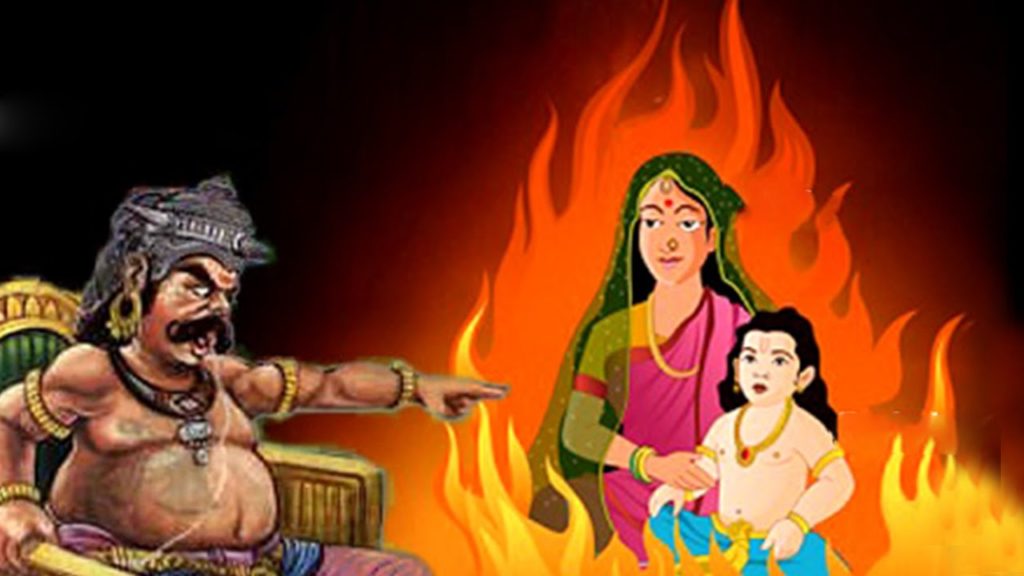
There was once a demon king by the name of Hiranyakashyap who won over the kingdom of earth. He was so egoistic that he commanded everybody in his kingdom to worship only him. But to his great disappointment, his son, Prahlad became an ardent devotee of Lord Naarayana and refused to worship his father.
Hiranyakashyap tried several ways to kill his son Prahlad but Lord Vishnu saved him every time. Finally, he asked his sister, Holika to enter a blazing fire with Prahlad in her lap. For, Hiranyakashyap knew that Holika had a boon, whereby, she could enter the fire unscathed.
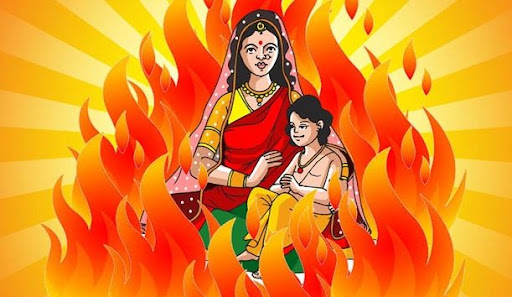
Treacherously, Holika coaxed young Prahlad to sit in her lap and she herself took her seat in a blazing fire. The legend has it that Holika had to pay the price of her sinister desire by her life. Holika was not aware that the boon worked only when she entered the fire alone.
Prahlad, who kept chanting the name of Lord Naarayana all this while, came out unharmed, as the lord blessed him for his extreme devotion.
Thus, Holi derives its name from Holika. And, is celebrated as a festival of victory of good over evil.
Holi is also celebrated as the triumph of a devotee. As the legend depicts that anybody, howsoever strong, cannot harm a true devotee. And, those who dare torture a true devotee of god shall be reduced to ashes.
Celebration of the LegendEven today, people enact the scene of 'Holika's burning to ashes' every year to mark the victory of good over evil. In several states of India, specially in the north, effigies of Holika are burnt in the huge bonfires that are lit. There is even a practice of hurling cow dungs into the fire and shouting obscenities at it as if at Holika. Then everywhere one hears shouts of 'Holi-hai! Holi-hai!'.
The tradition of burning 'Holika' is religiously followed in Gujarat and Orissa also. Here, people render their gratitude to Agni, the god of fire by offering gram and stalks from the harvest with all humility.
Further, on the last day of Holi, people take a little fire from the bonfire to their homes. It is believed that by following this custom their homes will be rendered pure and their bodies will be free from disease. At several places there is also a tradition of cleaning homes, removing all dirty articles from around the house and burning them. Disease-breeding bacteria are thereby destroyed and the sanitary condition of the locality is improved.
- 100 Whatsapp Messages for Holi Wishes In English
- 100 Whatsapp Messages for Holi Wishes In Hindi
- History of Holi
- Rituals of Holi
- Significance of Holi
- Tradition of Holi
- Holi Celebration
- Festival of Colours
- Evening of Bonfires
- Holi Pooja Process
- Holi 2025
- Celebrate an Eco Friendly Holi
Significance of Holi
Holi is considered as one of the most celebrated and revered festivals celebrated by the people of Hindu community in India. People in every part of the country and also those living in foreign country celebrate this festival with a...Know More
Holi Related Festivals
Holi is considered as an important festival of India and is celebrated around the country with great zeal and enthusiasm. There are also a great many of Holi related festivals that are celebrated in different states of India.Know More
Copyright © 2005- www.holifestival.org. All Rights Reserved


